RE: Fibreglass poles (was: Views of Wellington - 4)
Brent Efford
Tuesday, October 1, 2002 11:43 PM
Yes - I forgot to mention that on a previous visit to Graeme we went out in
a test run in 262, which is one of the 2 trolleys fitted with the
experimental poles. It was rigged up with test gear to check the dynamics of
retriever response, as part of his design work on the pole base
modifications.
Graeme showed how flexible his poles are by pulling the head of one down
beside the vehicle (the other was under the hook) and shaking it up and
down. It actually produced a noticeable 'sine wave' rippling down the length
of the pole. Another interesting outcome is that carbon skid wear on the
experimental buses is virtually non-existent, despite adjusting spring
pressure to keep the same contact pressure at the wire. This no doubt means
that there is less wear on the overhead, too, but the difference will only
be apparent when the whole fleet is equipped.
What is the construction of the Seattle poles?
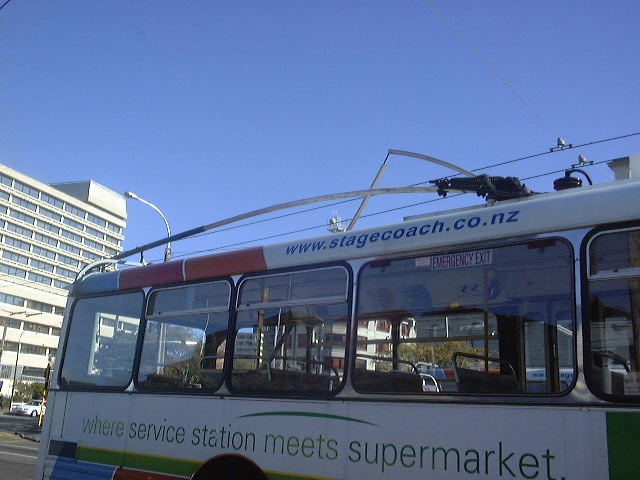
The remainder of the Wellington poles are aluminium. They track quite well,
but are prone to bending and breaking - e.g. this one at the temporary Bunny
St terminal which I shot the other day. Only the cable is keeping the end
attached. (In the new poles there is no internal cable - electrical
conductivity is provided by a light aluminium tube which also acts as a
mandrel during manufacture. The strength and insulation is provided by the
fibreglass exterior.)
Cheers,
Brent Efford
-----Original Message-----
From: Donald Galt [mailto:[email protected]]
Sent: Wednesday, 2 October 2002 8:44 a.m.
To: [email protected]
Subject: [TramsDownUnder] Fibreglass poles (was: Views of Wellington -
4)
On 1 Oct 2002 at 22:39, Brent Efford wrote:
We can attest to that in Seattle. From well off you can see one of the new
trolleys going through a switch, poles whipping like sawblades but staying
firmly attached to the wires.
Stagecoach may want to consider ways of ensuring that drivers don't exceed
the
speed limit through specialwork. Ours have become quite bold, some of them
even
a bit heedless.
Don
Your use of Yahoo! Groups is subject to http://docs.yahoo.com/info/terms/
------------------------ Yahoo! Groups Sponsor ---------------------~-->
Home Selling? Try Us!
http://us.click.yahoo.com/QrPZMC/iTmEAA/MVfIAA/DiTxlB/TM
---------------------------------------------------------------------~->
Your use of Yahoo! Groups is subject to http://docs.yahoo.com/info/terms/
a test run in 262, which is one of the 2 trolleys fitted with the
experimental poles. It was rigged up with test gear to check the dynamics of
retriever response, as part of his design work on the pole base
modifications.
Graeme showed how flexible his poles are by pulling the head of one down
beside the vehicle (the other was under the hook) and shaking it up and
down. It actually produced a noticeable 'sine wave' rippling down the length
of the pole. Another interesting outcome is that carbon skid wear on the
experimental buses is virtually non-existent, despite adjusting spring
pressure to keep the same contact pressure at the wire. This no doubt means
that there is less wear on the overhead, too, but the difference will only
be apparent when the whole fleet is equipped.
What is the construction of the Seattle poles?
The remainder of the Wellington poles are aluminium. They track quite well,
but are prone to bending and breaking - e.g. this one at the temporary Bunny
St terminal which I shot the other day. Only the cable is keeping the end
attached. (In the new poles there is no internal cable - electrical
conductivity is provided by a light aluminium tube which also acts as a
mandrel during manufacture. The strength and insulation is provided by the
fibreglass exterior.)
Cheers,
Brent Efford
-----Original Message-----
From: Donald Galt [mailto:[email protected]]
Sent: Wednesday, 2 October 2002 8:44 a.m.
To: [email protected]
Subject: [TramsDownUnder] Fibreglass poles (was: Views of Wellington -
4)
On 1 Oct 2002 at 22:39, Brent Efford wrote:
Graeme [Butler] is a real enthusiast anddifficult
a very keen design engineer - he designed some composite
aluminium/fibre-glass trolley poles 20 years ago, was snubbed by the
obstructive City Council management of the day ... but the poles are now
being tested in service and are proving a fantastic success - very
to dewire.
We can attest to that in Seattle. From well off you can see one of the new
trolleys going through a switch, poles whipping like sawblades but staying
firmly attached to the wires.
Stagecoach may want to consider ways of ensuring that drivers don't exceed
the
speed limit through specialwork. Ours have become quite bold, some of them
even
a bit heedless.
Don
Your use of Yahoo! Groups is subject to http://docs.yahoo.com/info/terms/
------------------------ Yahoo! Groups Sponsor ---------------------~-->
Home Selling? Try Us!
http://us.click.yahoo.com/QrPZMC/iTmEAA/MVfIAA/DiTxlB/TM
---------------------------------------------------------------------~->
Your use of Yahoo! Groups is subject to http://docs.yahoo.com/info/terms/